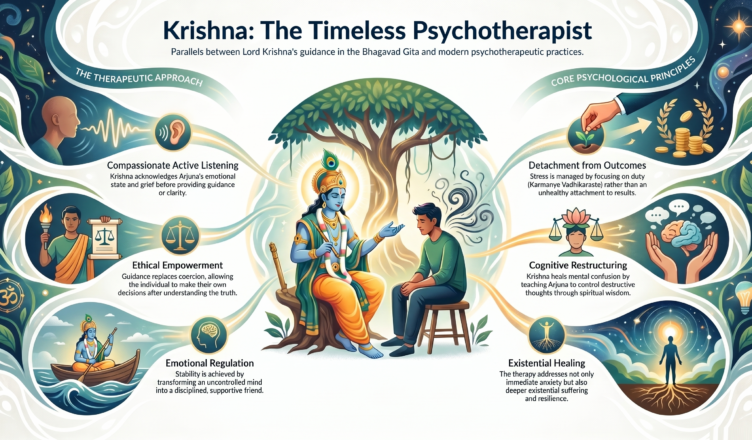

The Original Therapist: 5 Timeless Lessons on Mental Resilience from the Bhagavad Gita
A Dialogue Amidst the Chaos
In today’s fast-paced world, many of us stand on our own modern battlefields — overwhelmed by high-stakes decisions, uncertainty, anxiety, and emotional exhaustion. The heart races, the mind spins endlessly, and the future appears hidden beneath a fog of fear and confusion.
Yet this psychological struggle is not uniquely modern.
Thousands of years ago, on the battlefield of Kurukshetra, the warrior prince Arjuna experienced the same emotional collapse. His hands trembled, his skin burned, and the mighty bow Gandiva slipped from his grasp. He was not merely a warrior facing war — he was a human confronting a deep crisis of identity, morality, and purpose.
At this pivotal moment, Lord Krishna became far more than a charioteer or divine guide. He emerged as the “psychotherapist of the soul,” helping Arjuna navigate emotional paralysis through wisdom that closely resembles modern psychological therapy and cognitive restructuring.
The Bhagavad Gita, when viewed through a psychological lens, offers timeless lessons on mental resilience, emotional regulation, and inner stability.
- The Healing Power of Patient Listening
Krishna’s first response to Arjuna’s breakdown is not immediate advice or judgment.
He listens.
As Arjuna spirals into despair, Krishna allows him the space to fully express his fears, grief, guilt, anxiety, and confusion. Instead of offering quick fixes or dismissive reassurance, Krishna creates a compassionate emotional container where Arjuna feels heard and understood.
Why This Matters Today
Modern psychology recognizes that healing often begins when individuals feel emotionally validated.
Krishna demonstrates a timeless therapeutic principle:
“Listening before fixing.”
Before offering solutions, he acknowledges Arjuna’s suffering step-by-step, validating his humanity before addressing his confusion.
Key Takeaway
- Emotional clarity cannot be forced.
- Healing begins with compassionate listening.
- Validation reduces emotional isolation.
- Focus on Duty, Not Results
One of the most powerful teachings of the Bhagavad Gita is Krishna’s guidance to focus on action rather than outcomes.
Modern anxiety is often fueled by obsessive thinking about the future:
- What if I fail?
- What if things go wrong?
- What will people think?
Krishna redirects Arjuna away from fear-based thinking and toward purposeful action in the present moment.
“Karmanye Vadhikaraste”
कर्मण्येवाधिकारस्ते मा फलेषु कदाचन
This timeless principle teaches:
Perform your duty without attachment to the fruits of your actions.
Psychological Relevance
In modern psychology, this resembles process-oriented thinking — a proven antidote to performance anxiety and overthinking.
When we detach self-worth from outcomes and focus on effort, discipline, and intention, we reclaim mental energy wasted on fear.
Key Takeaway
- Focus on effort, not obsession with results.
- Presence reduces anxiety.
- Purposeful action creates mental resilience.
- The Mind Can Become Your Greatest Ally
Krishna explains that the human mind is not fixed; it can either uplift us or destroy our peace depending on how we train it.
An uncontrolled mind becomes restless, impulsive, fearful, and self-destructive.
A disciplined mind becomes a source of strength.
“The uncontrolled mind becomes one’s enemy, while a disciplined mind becomes the greatest friend.”
Ancient Wisdom Meets Modern Psychology
This teaching parallels modern concepts such as:
- Cognitive restructuring
- Emotional regulation
- Mindfulness
- Self-awareness
Krishna teaches that resilience comes not from controlling the world, but from mastering our inner responses.
Key Takeaway
- Thoughts are not always truth.
- Self-awareness creates emotional freedom.
- Mental discipline builds inner stability.
- True Guidance Empowers — It Does Not Control
Perhaps the most remarkable aspect of Krishna’s counsel is that he never forces Arjuna to obey.
Despite possessing divine authority, Krishna refuses coercion.
Instead, he offers wisdom, perspective, compassion, and clarity — then leaves the final decision to Arjuna himself.
This is ethical guidance at its highest form.
Why This Matters
Healthy mentorship, therapy, and leadership should:
- Encourage independent thinking
- Restore personal agency
- Empower rather than dominate
Krishna helps Arjuna discover truth for himself instead of demanding blind obedience.
Key Takeaway
- Real guidance empowers autonomy.
- Compassion is more transformative than pressure.
- Personal realization creates lasting change.
- Resilience Is Inner Mastery, Not Absence of Conflict
The Bhagavad Gita does not promise a life free from struggle.
Instead, it teaches that resilience emerges from mastering our internal reactions to external chaos.
The battlefield remains.
But Arjuna changes.
This is the true transformation at the heart of the Gita.
Modern Relevance
The dialogue between Krishna and Arjuna addresses more than temporary stress. It speaks directly to:
- Existential anxiety
- Emotional burnout
- Fear of failure
- Identity crises
- Decision paralysis
- Mental exhaustion
Its message remains profoundly relevant in an age dominated by uncertainty and overstimulation.
Final Thoughts: A Blueprint for the Modern Soul
The Bhagavad Gita is not merely a spiritual scripture — it is also a timeless guide to emotional resilience and psychological clarity.
Through patience, disciplined thinking, mindful action, and compassionate guidance, Krishna helps Arjuna reclaim his inner strength.
And perhaps that is the enduring lesson for us all:
Resilience is not the absence of chaos.
It is the mastery of our response to it.
Reflective Question
Which part of your own inner battlefield could benefit from this ancient wisdom today?
The answer may be the first step toward emotional liberation.
if you have any question ,feel free to contact .