- Introduction: The Silent Room
Picture a dinner table where the only sound is the rhythmic clinking of silverware. Across the room, a business meeting stalls as a supervisor’s eyes drop to a buzzing screen. This is “The Silent Room”—a space where everyone is physically present, yet no one is truly there. We have entered the era of “phubbing,” a portmanteau of phone and snubbing, and it is arguably the most pervasive social habit of our time.
As of 2023, approximately 86.11% of the global population—roughly 6.92 billion people—own a smartphone. These devices have consolidated our watches, maps, and social lives into a single, pocket-sized interface. But this convenience comes with a high relational tax. By synthesizing a decade of research (2014–2024), we can see that phubbing is more than a modern annoyance; it is a fundamental shift in human interaction that erodes the “affective dimension” of our bonds. This post explores why we can’t look away and how we can reclaim the room.
- It’s a Survival Instinct, Not Just Rudeness: The Reciprocity Loop
Why is phubbing so contagious? When you are “phubbed,” you don’t just feel minor irritation; you feel a distinct sting of social exclusion. Recent research from Argentina highlights that phubbing has quickly moved from an isolated behavior to a “Social Norm.” According to Social Exchange Theory, human interaction is often a transactional balance of costs and rewards. When someone ignores you for a screen, the “cost” of the interaction skyrockets, making you feel undervalued.
To mitigate the discomfort of being sidelined, we use our screens as digital shields. We turn to our own phones to “reclaim inclusion,” creating a chilling “Reciprocity Loop.” The Argentine study confirms that phubbing becomes a reciprocal behavior regardless of the suffering it might cause others; we become the very thing we hate simply to feel connected again.
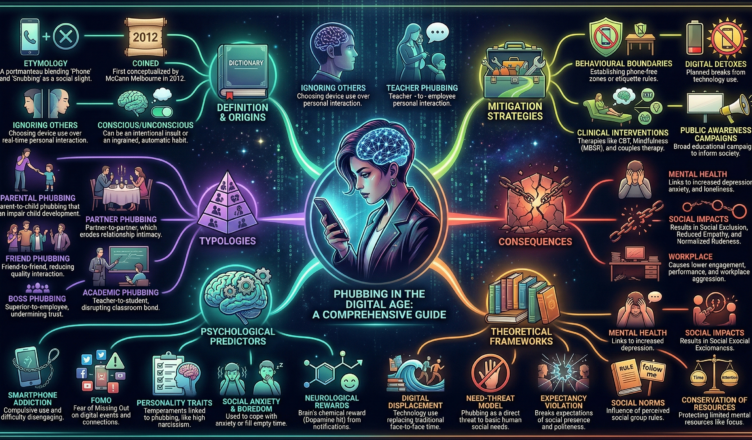
“Phubbing refers to conscious and unconscious behaviours exhibited by individuals who ignore others in social settings by persistently using or looking at their smartphones, resulting in social disconnection.”
- “B-Phubbing” and the Erosion of Professional Trust
The damage of phubbing is most acute in professional and academic hierarchies. “Boss Phubbing” (B-Phubbing) occurs when a supervisor prioritizes a notification over a subordinate. This isn’t just a breach of etiquette; it destroys the “affective dimension” of the relationship—the emotional warmth and trust necessary for collaboration.
The primary victim is eye contact, a critical non-verbal cue that signals value. This erosion of trust isn’t limited to the office. Research into “Teacher Phubbing” (T-Phubbing) shows that when educators disengage during consultations, students experience decreased motivation and a sense of alienation. In both cases, phubbing acts as an organizational killer, signaling that the human in front of you is a lower priority than the digital data in your palm.
- The Fear of Missing “Information” vs. Missing “People” (FOMO-NI)
We often blame “Fear of Missing Out” (FOMO) for our habits, but we need to be more precise about what we actually fear. Psychologists distinguish between:
- FoM-SO (Fear of Missing Social Opportunities): The worry that peers are having a rewarding experience without you.
- FoM-NI (Fear of Missing Novel Information): The compulsive hunger for notifications, news, and updates.
A striking takeaway from recent studies is the irony of our priorities: individuals often phub more out of a hunger for novel information (FoM-NI) than for actual social interaction. We are literally ignoring a real-life social opportunity in favor of a digital “hit” of information. In our rush to stay “informed,” we leave ourselves socially starved.
- Your Brain on “Digital Displacement”
To understand why the pull of the screen is so powerful, we must look at Digital Displacement Theory (DDT). This framework explains how digital engagement replaces real-world interaction across three dimensions: emotional, cognitive, and social.
Neurologically, this is reinforced by the brain’s reward system. Every notification triggers the mesolimbic pathway, releasing a hit of dopamine that reinforces the phone-checking habit. For many, phubbing becomes a “maladaptive coping mechanism” for boredom or social anxiety. The screen offers a predictable, low-effort reward, whereas a live human requires the “work” of active listening and emotional regulation. Over time, the predictable screen wins, and the human relationship suffers “cognitive displacement.”
- The “Invisible” Victim: Parental Phubbing and Child Development
Perhaps the most concerning findings involve “Parental Phubbing.” While parents may attempt to compensate for their distraction by providing children with their own gadgets, children require “active engagement” and shared attention to develop healthily. When parents prioritize devices, it disrupts attachment bonds and can lead to long-term psychological distress.
“Excessive social media use is associated with social withdrawal, fragmented attention, and diminished quality of face-to-face interactions… leading to what can be described as social atrophy and alienation.”
This “social atrophy” is a precursor to adolescent depression and insecurity. When a child is phubbed by a caregiver, they learn that they are less important than the digital world, creating a foundation for social withdrawal later in life.
- The Path Forward: Reclaiming the Room
Reclaiming our attention requires more than just willpower; it requires structural changes and “phone etiquette.” Based on research-backed interventions, here is how to start:
- Establish “Tech-Free Zones”: Designate the dining table or the bedroom as zones where phones are strictly prohibited to foster presence.
- The “Imago Dialogue”: Couples can use this structured communication technique to ensure each partner feels heard and valued, effectively “healing” the digital divide.
- Digital Detoxes: Regularly scheduled breaks from social media can lower FoM-NI and recalibrate your brain’s dopamine-driven reward system.
- Institutional “Phone Etiquette”: Schools and workplaces should implement clear guidelines to prioritize eye contact and focused mentorship during meetings and lectures.
- Conclusion: A Question of Presence
The research is clear: phubbing is not a trivial byproduct of the digital age. It is a behavior with far-reaching consequences for our mental health, our professional trust, and our children’s development. As we navigate a world where 86% of us are constantly “connected,” we must decide how we value our limited supply of attention.
In our rush to stay “connected” to the world at large, who are we leaving behind in the chair right across from us? The next time your phone buzzes in the middle of a conversation, remember that the most rewarding “novel information” might just be the person looking you in the eye.

Audio podcast on this topic .