Introduction: A New Frontier in Brain Chemistry
Adults living with Attention-Deficit/Hyperactivity Disorder (ADHD) often find themselves caught in a clinical catch-22. While traditional stimulants offer immediate results, they are frequently accompanied by the “crash” of a short half-life and the persistent red flags of abuse liability. Conversely, standard non-stimulants offer a safer regulatory profile but demand a frustrating degree of patience, often requiring a month of consistent dosing before the patient feels any tangible benefit.
Centanafadine, a novel “triple reuptake inhibitor,” is currently emerging as a potential bridge across this therapeutic divide. By simultaneously targeting three major neurotransmitter systems, this compound challenges the binary categorization of ADHD treatments. This article explores the latest findings from Phase 2 and Phase 3 clinical trials, examining how this “triple threat” mechanism impacts efficacy in both ADHD and Binge Eating Disorder (BED).
The Triple Threat: A Unique Mechanism of Action
To understand the novelty of Centanafadine, one must first look at the underlying pathophysiology of ADHD. Recent research suggests the condition stems from a dysregulation in the complex interplay of adrenergic and dopaminergic neurotransmission, leading to impaired connectivity in the brain’s executive function and reward processing networks. Centanafadine acts as a potent inhibitor of norepinephrine, dopamine, and serotonin reuptake transporters (SNDRI), a broader approach than current treatments that typically neglect the serotonergic system.
This “triple action” is increasingly viewed as a vital stabilization tool for complex neurobehavioral conditions. By inhibiting the reuptake of serotonin alongside dopamine and norepinephrine, the drug may help stabilize the connectivity networks that are often fractured in the ADHD brain. This unique pharmacodynamic profile allows for a nuanced modulation of brain chemistry that mimics the efficacy of stimulants without their typical pharmacological baggage.
“Centanafadine is an inhibitor of norepinephrine, dopamine, and serotonin reuptake transporters that is considered to be a stimulant with nonstimulant characteristics.”
The One-Week Window: Redefining Speed of Treatment
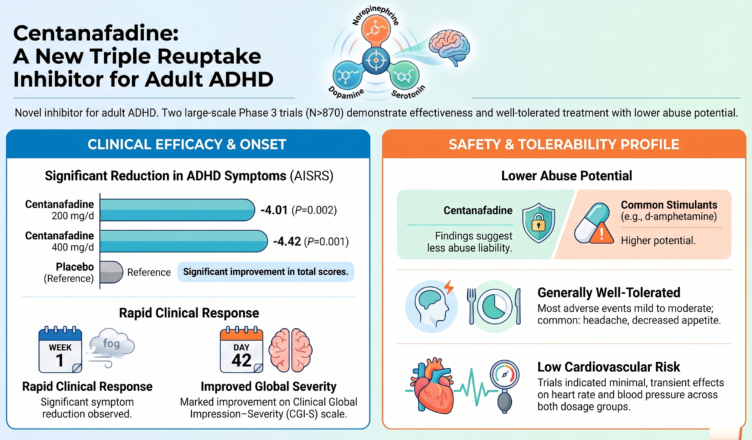
Data from two pivotal Phase 3 trials—NCT03605680 (Study 1) and NCT03605836 (Study 2)—suggest that Centanafadine may redefine expectations for non-stimulant onset. Traditional options like atomoxetine typically require a 2-to-4-week lead time to reach maximal effect, a delay that often discourages patients who struggle with medication adherence. Centanafadine, however, demonstrated statistically significant improvements much earlier in the treatment cycle.
In Study 2, clinicians observed a significant reduction in Adult ADHD Investigator Symptom Rating Scale (AISRS) scores as early as day 7. Peak total score reductions reached 32.2% in Study 2, while Study 1 saw a 24.6% reduction specifically associated with the 400 mg/d dose. Interestingly, results in Study 1 were more significant by Day 28, illustrating that while onset can be rapid, the drug’s full therapeutic reach continues to evolve over the first month of treatment.
The Abuse Paradox: A Stimulant Recreational Users Might Avoid
Perhaps the most intriguing aspect of Centanafadine’s development is its “abuse paradox.” While the drug provides stimulant-level efficacy, human abuse liability studies (NCT02144415) involving the immediate-release (IR) formulation found that experienced recreational users actually considered the drug “aversive.” Unlike the reinforcing euphoria associated with d-amphetamine or lisdexamfetamine, Centanafadine was described as actively unpleasant in initial doses, similar to the profiles of other triple reuptake inhibitors like tesofensine or bupropion.
This low reinforcement profile is backed by safety data showing zero reports of “euphoric mood” throughout the Phase 3 clinical program. Experts noted a unique “hook” effect at Day 35–42, where improvements plateaued slightly after the administration of the Study Medication Withdrawal Questionnaire (SMWQ), perhaps due to the psychological anticipation of ending treatment. Nevertheless, the lack of addictive potential suggests that Centanafadine could eventually bypass the heavy regulatory hurdles and prescribing stigmas associated with Schedule II substances.
Expanding the Scope: The Binge Eating Connection
The therapeutic utility of Centanafadine is also being investigated beyond the realm of focus. Clinical data from the Veeva database (NCT05113953) highlights a Phase 2 investigation into Binge Eating Disorder (BED), involving 147 adult patients with moderate to severe symptoms. Over an eight-week trial period, researchers tested total daily doses (TDD) of 200mg and 400mg to evaluate the drug’s impact on binge frequency and severity.
This expansion is a logical progression given that BED is often driven by dysregulated reward processing and a lack of inhibitory control. Because Centanafadine specifically targets the reward pathways via dopamine and serotonin, it is uniquely suited to treat the executive function deficits at the heart of eating disorders. This suggests a future where SNDRIs serve as a versatile toolkit for a spectrum of impulsive and compulsive neurobehavioral conditions.
Real-World Tolerability: What the Trials Actually Found
The Phase 3 trials utilized a rigorous “placebo run-in” phase to filter out rapid placebo responders, a design choice that significantly strengthens the validity of the final efficacy results. Most Treatment-Emergent Adverse Events (TEAEs) were categorized as mild to moderate, with the frequency increasing slightly at higher dosages.
The most frequently reported side effects included:
- Headache and Dry Mouth
- Decreased Appetite and Nausea
- Insomnia and Irritability
While the cardiovascular profile was generally favorable, a truly cognizant analysis must note rare incidents of tachycardia and hypertension. These outliers remained low and transient across the study population, suggesting that while the drug is well-tolerated, clinicians should maintain standard monitoring of vital signs.
Conclusion: The Future of Neuropsychiatry
Centanafadine represents a significant shift in neuropsychiatric pharmacology, offering a “third way” for patients who cannot tolerate traditional stimulants or wait for legacy non-stimulants. By harnessing triple reuptake inhibition, the drug provides a rapid clinical response while maintaining a low-liability profile. This balanced approach may ultimately change our fundamental understanding of how to treat comorbid mood and behavioral disorders.
As we look toward a future where focus and safety are no longer mutually exclusive, we must ask: Are we entering an era where the ‘Schedule II’ stigma of ADHD treatment finally becomes obsolete? If we can provide patients with the executive control they need without the risk of dependency, the boundaries of mental health treatment in our high-performance world are about to be redrawn.